what would make a slope susceptible to failure during a ground motion event?
Natural hazards geoscience
Natural hazards are Globe processes with the potential to damage people or property; natural disasters result when society is affected by a hazardous event.
Owing to global population pressures, more people live in areas vulnerable to natural disasters. As a issue, the loss of life, private belongings, and infrastructure resulting from natural disasters is rising. Although commonly called "Acts of God", natural disasters result from mass and energy transfers that have operated on Earth since it formed, 4.6 billion years ago. More importantly, natural disasters generally result from the inability of humans to anticipate, and programme for, inevitable hazardous events.
British Columbia is peculiarly vulnerable to natural hazards. For example, earthquakes, tsunami, and volcanoes are generated along the western flank of the province, as the tectonic plates that floor the Pacific Ocean drive beneath N America. Furthermore, British Columbia'southward mountainous terrain makes information technology prone to landslides, glacial outburst floods, snow avalanches, and seasonal floods, and its extensive coastlines are exposed to tempest surges, seismic sea wave that propagate across the Pacific Ocean from distant plate boundaries, and the furnishings of sea-level rising.
The following links volition guide yous to natural hazard resources developed past the British Columbia Geological Survey
British Columbia Geological Survey natural adventure resources
P.A. Monahan, V.M. Levson, P. Henderson, A. Sy, E.J. McQuarrie, and S.G. Edible bean
The objective of these maps are to show areas of Greater Victoria where the earthquake hazard is likely to be increased due to the presence of potentially unstable slopes, and soils susceptible to amplification of ground motion and/or liquefaction.
View Geoscience Maps 2000-03
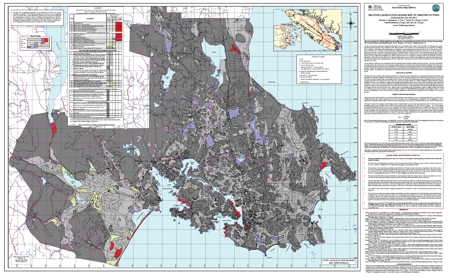 Sheet 3A: Relative Liquefaction Take a chance Map of Greater Victoria (Map and Accompanying Study); by P.A. Monahan, V.M. Levson, P. Henderson, and A. Sy
This map shows areas of Greater Victoria in which the earthquake run a risk is potentially increased due to the presence of soils susceptible to liquefaction. Liquefaction is the transformation that occurs when convulsion shaking (or other disturbance) causes a saturated granular soil to lose its strength and behave like a liquid and can be one of the major causes of damage during an earthquake. The susceptibility of a site to liquefaction depends on the depth to water table and the density, grain size and age of the underlying deposits. This map was prepared past assigning a hazard rating to each geological map unit based on these criteria and quantitative analyses.
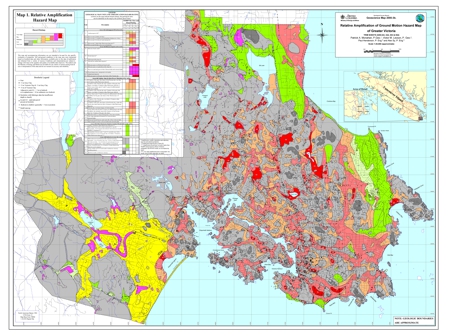 Sheet 3B: Relative Amplification of Ground Motion Take chances Map of Greater Victoria (Map and Accompanying Report); past P.A. Monahan, Five.M. Levson, P. Henderson, and A. Sy
This map shows areas where the earthquake adventure is increased due to distension of footing motion. The distension of ground move hazard has been estimated on the footing of the National Convulsion Hazard Reduction Programme (NEHRP) site classes for the susceptibility to distension of ground motion (Edifice Seismic Safety Council, 1994), which are based on the average response of various types of soils.
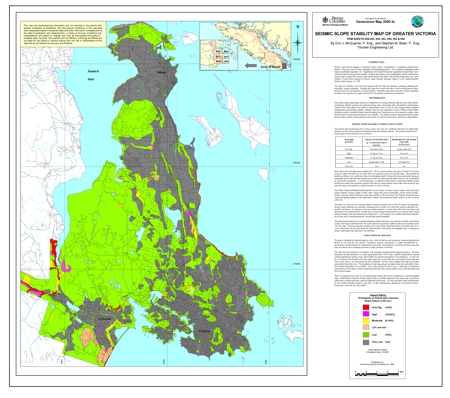 Sheet 3C: Seismic Slope Stability Map of Greater Victoria (Map); by E.J. McQuarrie, and S.M. Bean
Seismic gradient hazard mapping is intended to show relative susceptibility to earthquake-induced slope failures. The seismic gradient hazard map is based on a compilation of existing subsurface data, previous slope stability assessments, bedrock geology and surficial geology maps, topographic data, and airphoto interpretation. Stability analyses were conducted on twelve different slope models including typical or simplified slopes found throughout the Victoria area too equally specific, circuitous slope models where more detailed information was available. The stability analyses determined both the static factor of safety and the yield acceleration (the intensity of seismic motions that would cause a slope failure).
Relative Convulsion Hazard Map of Greater Victoria, Showing Areas Susceptible to Amplification of Ground Motion, Liquefaction and Earthquake-Induced Slope Instability
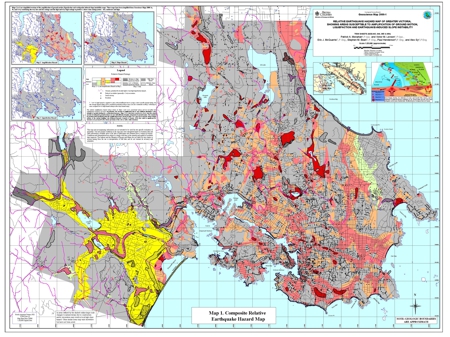
This map has been compiled from three other maps: a relative liquefaction hazard map, a relative amplification of basis motion hazard map, and an convulsion-induced slope instability hazard map.
View Geoscience Map 2000-01
P.A. Monahan, Five.Thousand. Levson and B. Kerr
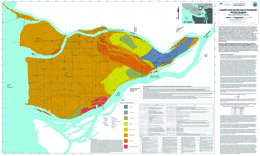
The City of Richmond, British Columbia, is located in ane of the near seismically active regions in Canada (Rogers, 1998). The effects of earthquakes are not only dependent upon the magnitude of the convulsion and the distance from the source, just tin can vary considerably due to local geological conditions. These atmospheric condition can be mapped using existing geological and geotechnical data. This map shows the variation in the convulsion-induced liquefaction hazard in the Urban center of Richmond, BC. The urban center is located entirely inside the modernistic Fraser River delta, and the deltaic sediments on which the city is built are particularly susceptible to earthquake induced liquefaction (east.1000. Byrne, 1978; Finn et al., 1989; Byrne and Anderson, 1991; Clague et al., 1992, 1997, 1998b; Watts et al., 1992). This map has been prepared as part of an earthquake hazard mapping project in the city. An accompanying map shows the Quaternary geology of the Richmond surface area (Geoscience Map 2010-2).
View Geoscience Map 2010-03
V.G. Levson, P.A. Monahan, D.G. Meldrum, P.F. Matysek, A. Sy, 50. Yan, B.D. Watts and R.F. Gerath
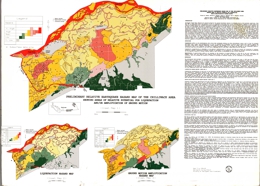
The earthquake hazard map of Chilliwack is the first map of its kind to be released by the British Columbia Geological Survey. Earthquake take chances maps show areas where the hazards due to earthquakes are increased due to local geological conditions, such every bit the presence of sandy soils susceptible to liquefaction, thick deposits of soft dirt that can amplify earthquake footing motions, and unstable slopes that could fail. Damage due to earthquakes is commonly full-bodied in such areas. The prime users of earthquake hazard maps are borough planners, engineers and building inspectors, emergency response planners, public officials responsible for prioritizing seismic upgrades, insurance companies, engineers and the public.
The Chilliwack map shows areas of relative potential for liquefaction, and amplification of ground move, individually and combined. These maps were prepared by integrating new surface geological mapping with an extensive database of geotechnical testholes and water well logs to produce a subsurface geological model of the Fourth deposits of the area. The liquefaction potential of each geological map unit is based on the sediment types present, their properties, and the expected frequency and forcefulness of earthquakes. Past this method, the hazard due to liquefaction is quantified and can be compared directly with the liquefaction gamble in other areas of the province. The amplification susceptibility of each geological map unit of measurement was determined by correlation of the sediment types present with the amplifications that take been observed in similar sediments during earthquakes. The combined gamble map was prepared by taking the higher of the 2 hazards for each map unit. Within the Fraser Lowland, the combined run a risk rating ranges from low on alluvial fans and on the Cheam Slide, to high and very loftier along channels of the Fraser River and in areas where thick surficial silts and peats occur. The hazard rating is depression to very depression along the lower slopes of the Cascade Mountains and within bedrock inliers in the Fraser Lowland.
View Open File 1996-25
edited past V.Yard. Levson and South. Jonnes
Matthew A. Mabey and Ian P. Madin: Earthquake Adventure Assessment, The Local Geologic Component
Gerald O. Uba: Applications of Convulsion Hazard Maps to Land-Use and Emergency Planning, Examples from the Portland Area
Cliff Marks: Applications of Earthquake Chance Maps to Land-Use Planning and Regulations in Seattle
Thomas C. Vlasic: Land-Use Applications of Earthquake Gamble Maps, California Experience
Victor 1000. Levson, Paul F. Matysek, Patrick A. Monahan and Bryan D. Watts: Earthquake Gamble Mapping in British Columbia: Status, Demand and Methodology Evolution
Bryan D. Watts and South.W. Hollingshead: Seismic Microzonation Assessment and Map-ping for Land-Use Planning: Data Availability, Survey Results and Revised Data Model
Patrick A. Monahan and Victor Thou. Levson: Chilliwack Seismic Microzonation Project - Data Drove and Geological Overview
Harold D. Foster, Norman Due east. Hardy and Colin J.B. Wood: The Role of Earthquake Take a chance Mapping in Disaster Simulations and Exercises: Case Studies from British Columbia
Ann M. Katrichak, James F. Finch, Tim Eastward. Little and Fred P.P. Turner: A Due west Declension Utility's Arroyo to Mitigating Earthquake Hazards
Chang-Jo F. Chung and Yvon Leclerc: Use of Quantitative Techniques for Zoning Landslide Hazard
View Paper 2003-02
rogersagempiesent1986.blogspot.com
Source: https://www2.gov.bc.ca/gov/content/industry/mineral-exploration-mining/british-columbia-geological-survey/geology/natural-hazards-geoscience

Post a Comment for "what would make a slope susceptible to failure during a ground motion event?"